
How to split bills based on income: proportional split, calculated for you
No install, no sign-up. 100% free.
For example, a trip for friends with different incomes
2 working full-time, 1 part-time, 1 student. Lodging, car and dinner were paid separately.
Split 4 ways? Same for the student? Who pays whom?
With FAMI-KAN, just set the ratios
Who pays whom
WHY FAMI-KAN
No sign-up, no limits, no black box
accounts or installs
Just paste a link in your group chat.
entries and members
No daily caps, no paid plan.
currencies, 8 languages
Works for trips abroad and mixed-language groups.

Shared pot (deposits) supported
Collect money up front; refunds and top-ups are settled automatically. Rare among no-sign-up apps.

Everyone can answer "why this amount?"
Who carries which ratio, what the base amount is. The whole calculation is always visible.
ABOUT THIS APP
What FAMI-KAN is
From everyday bills to trips, decide fairly who pays how much.
Adults 1.0, kids 0.5.
Split per person or per household, and set any ratio. Everyone's share is calculated automatically.
Just share a link.
No app to install, no account to create. Everyone adds what they paid from their own phone.
Who pays whom, how much. Instantly.
The fewest transfers to settle up, and every calculation visible to everyone. No black box.
HOW IT WORKS
How it works, in 4 steps

1Add households and set ratios
Adults 1.0, kids 0.5. Each household's total ratio is computed for you.
2Everyone enters what they paid
One family paid the rental car, another the hotel. Each from their own phone.
3Here's the result
Who pays whom, how much, in the fewest transfers.
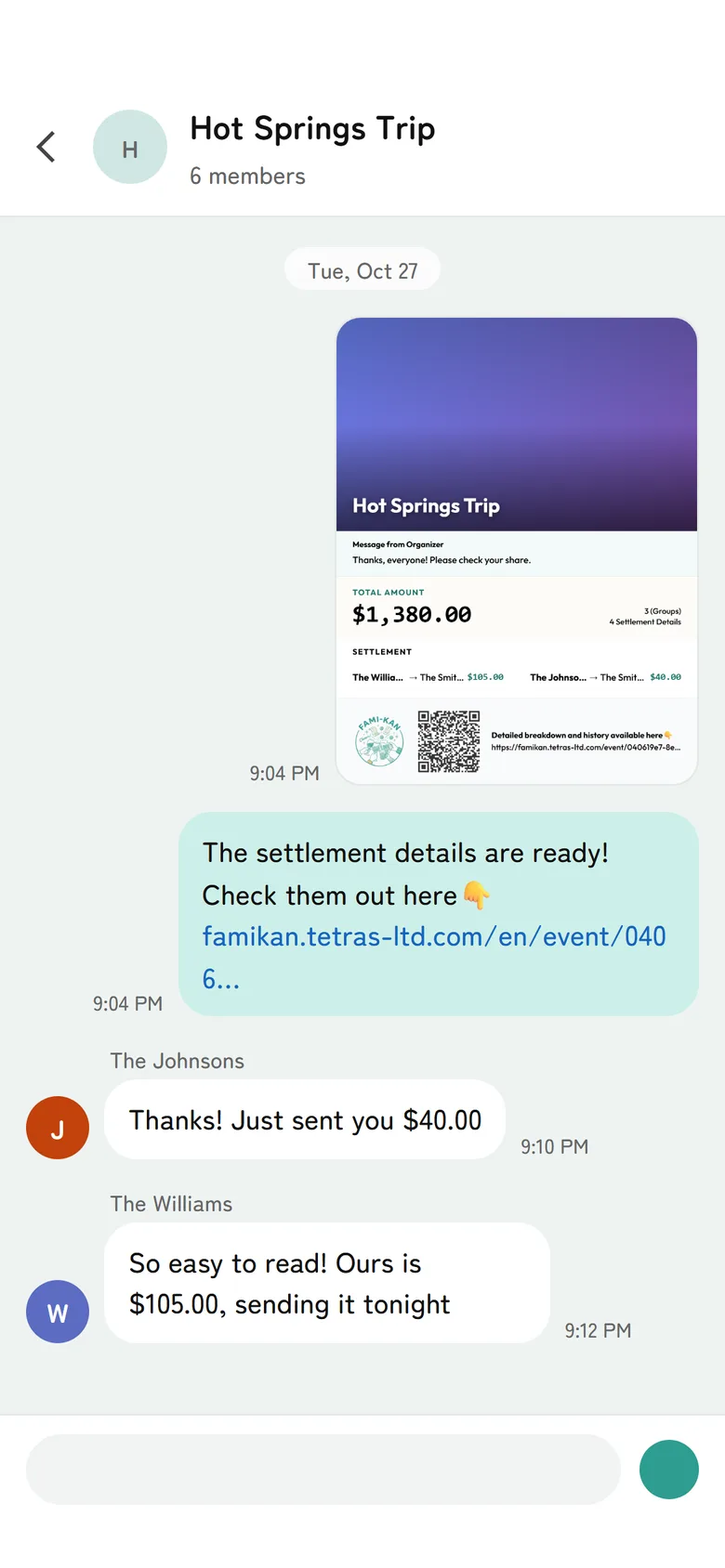
4Send it and you're done
Share the result as one image, or copy the text for payment apps.

MoreHistory by date
Who paid for what, grouped by day. You can re-sort it too.
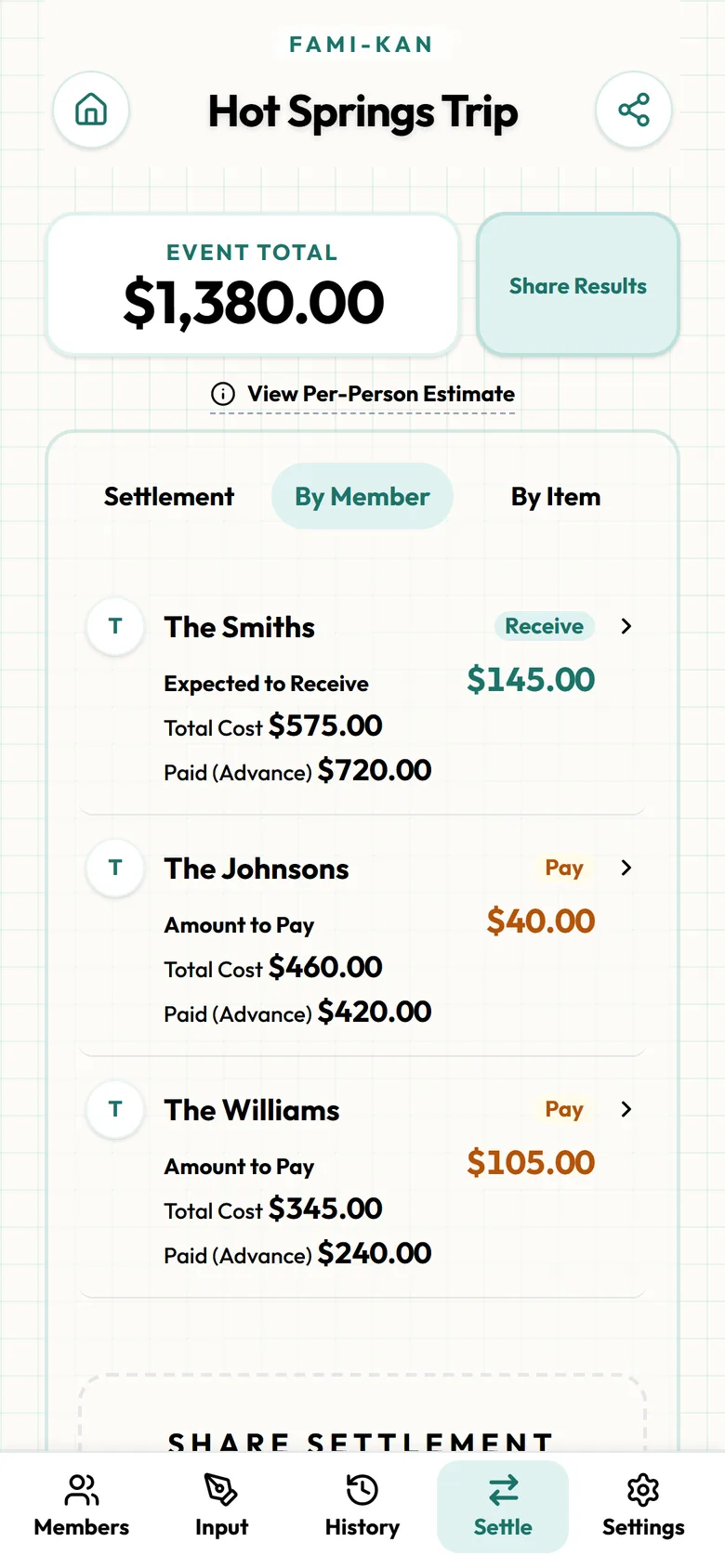
MoreBy Member
Each family's share, what they paid, and what they get back or owe.
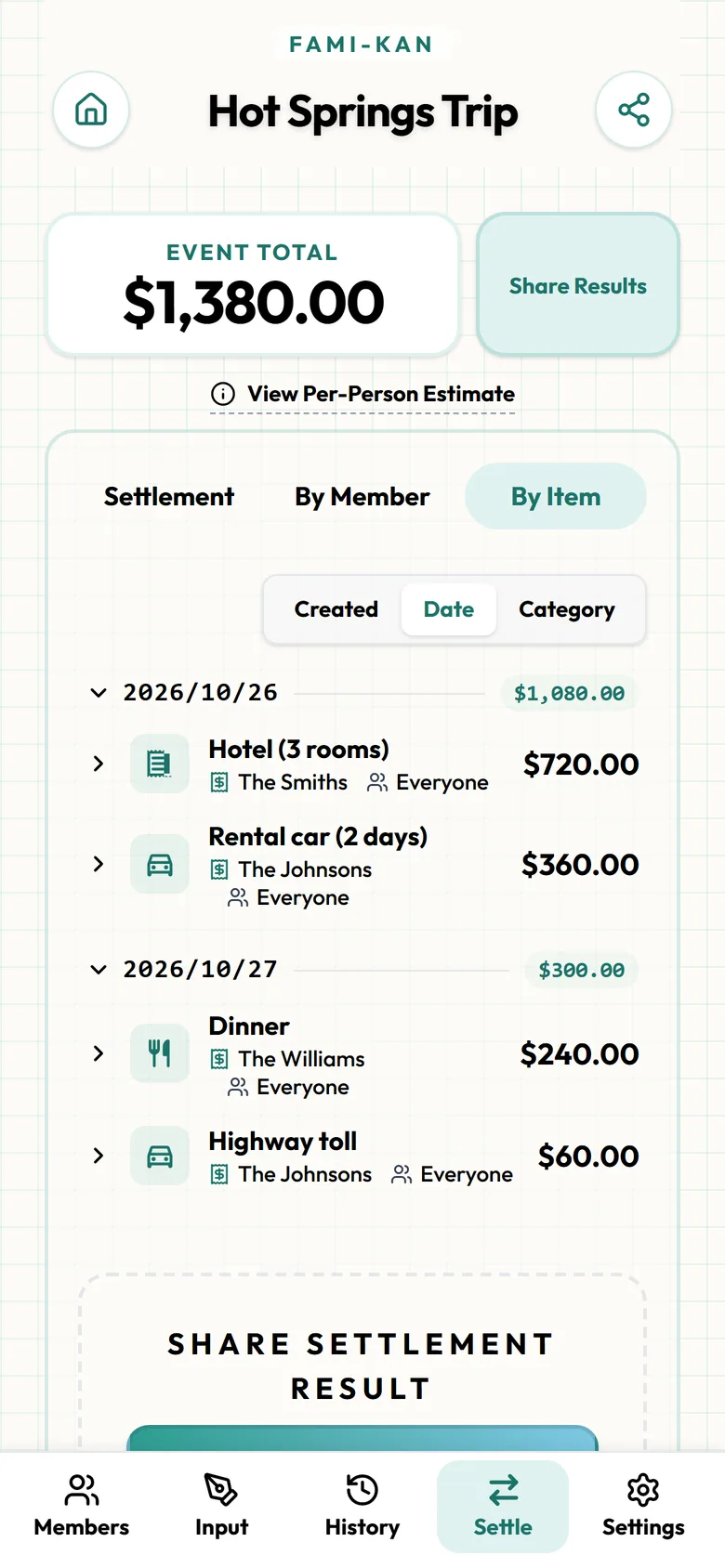
MoreBy Item
What the money went on, by date or by category.

MoreSettlement card
One image to post in the group chat. The QR code opens the full details.
Any of these sound familiar?
Same share for a student and a full-time worker?
What is a proportional split in money?
Nobody wants to do the math
→ Split by income, on your phone.
Set income ratios and log what everyone paid. FAMI-KAN calculates each person's proportional share and who owes whom. Works for friends with different incomes, couples and roommates. No sign up, completely free.
Don't let tedious money calculations ruin a great memory.
Students and full-time workers on the same trip; an equal split is hard on the students.
Set ratios like 1.0 for workers and 0.4 for students, and FAMI-KAN shows everyone's share and the settlement.
Splitting proportionally to income means a lot of math.
Enter the ratios and FAMI-KAN does the math. The per-person estimate shows the amount for each group.
How should we set the ratios?
Use your actual income ratio, or round it to a few levels. Change it any time and everyone's amount updates, so you can decide together.
FAMI-KAN needs no sign-up and no install. Set a ratio once — Adult 1.0, Child 0.5 — and it applies to every expense after that. We compare it with other apps, including where they do better.
Why FAMI-KAN is Best
Splitting bills based on income means everyone pays the same percentage of what they earn rather than the same dollar amount. If Ana earns $6,000 a month, Ben $4,000 and Cy $2,000, their incomes are in a 3:2:1 ratio, so on a $1,200 bill they pay $600, $400 and $200. One bill is easy. The hard part is that real life has dozens of bills paid by different people at different times. Say Ana pays $1,200 rent and Ben pays a $300 utility bill. The total is $1,500, so the shares are $750, $500 and $250. Ana paid $450 more than her share, so Ben sends her $200 and Cy sends her $250. Doing that by hand every month, or keeping a spreadsheet formula working, quickly gets tedious. In FAMI-KAN, give each person a ratio, such as 3, 2 and 1 or 1.5, 1.0 and 0.5, and log payments as they happen. Only the ratios are entered, never anyone's salary. The settlement shows each person's proportional share and who pays whom in the fewest transfers.
Simple 3-Step Guide
No app downloads or accounts needed.
- 1
Agree on ratios
Work out each person's income ratio, such as 3:2:1, and round it if you like.
- 2
Create the event
Start an event, add everyone and give each person their ratio. No account is needed.
- 3
Log every bill
Whoever pays enters it from their own phone. Switch any single bill to an even split if you agree to.
- 4
Settle up
Open the Settle tab for each person's proportional share and who pays whom in the fewest transfers.
Why we built FAMI-KAN
FAMI-KAN isn't just a calculator. It's a partner that handles the math so you can focus on what matters: "That dinner was amazing", "Where should we go next?" — preserving the afterglow of time well spent together.
Read more
The worst part of any trip comes at the very end — when everyone's tired and someone has to sort out the money. Lining up receipts, punching numbers into a calculator, trying to remember who paid what... it brings a cold, transactional feeling to what should be warm memories.
Existing apps are useful, but often too complex or require everyone to install the same app. For family gatherings spanning multiple generations, we needed something simpler — and warmer.
Need business-style splitting?
FAMIKAN Smart for Business & Dinners
"Seniors pay more", "Students pay less", "Late arrivals get adjusted" — complex tiered splits are set up in seconds with presets. Features like edit-locking and graph-enabled share text are built for organizers.
- • Role-based tiered split presets
- • Edit lock & graph-enabled sharing
- • Perfect for work dinners & mixers
Frequently Asked Questions
Each person pays a share in proportion to their income. With incomes of $6,000, $4,000 and $2,000, the ratio is 3:2:1, so a $1,200 bill becomes $600, $400 and $200. Everyone gives up the same percentage of their income.
Yes. Keep the income ratio as the default for rent and utilities, and use "Change shares for this payment only" on things you'd rather split evenly, such as concert tickets everyone wanted equally. On a $150 order for three, that's $50 each.
A ratio of 0 means they pay nothing, which may not feel right to them either. A small ratio, such as 0.2, keeps them contributing a little, and you can raise it once their situation changes.
No. FAMI-KAN only stores the ratios you enter, such as 3, 2 and 1. How you arrive at those numbers can stay between you.
Changing a ratio recalculates every payment in the event. To keep past bills as they were, settle and lock the current event, then duplicate it from the history on the home page and enter the new ratios.
Give each payment a date and category, then sort the History tab by date or category. When you settle, the Settle tab shows the transfers that even things out, and you can record them under "Settled payments".
Yes. Every bill-splitting and settlement feature is free to use, and no registration is required.
No. It runs entirely in your web browser. Just share the link and everyone can access it immediately on their phones.
Yes, you can select the currency when creating an event (almost every official currency in the world). You can unify calculations easily for trips abroad.
Yes. You can switch between three views — "Settlement", "By Member" and "By Item". You can see what each person paid and owes, and for any single expense, who is covering how much. Everyone sees why the number is what it is, on the same screen.